
85% of Bangladesh’s population depend on agriculture for their livelihoods. However, despite being the backbone of the economy, most small-scale farmers live below the poverty line. Their income is not enough to meet their basic needs.
Transform Trade has worked alongside smallholders in rural Bangladesh since 2015, supporting them to get a fair deal for their work, increase their incomes, manage the impact of climate change and tackle exclusion and gender inequality. SWABOL (‘Self reliance project’) is an EU-funded project led by Transform Trade and partners in Bangladesh which builds on over a decade of work running projects empowering rural communities. These groups have, for the first time, established a national platform for farmers in Bangladesh.
SWABOL works with 47,000 of Bangladesh’s most vulnerable smallholder farmers, through 46 Farmer-led Associations, to help them:
get a better deal from trade;
register farms and business as legal entities;
engage local and national government on pressing issues;
establish alliances for advocacy;
build inclusion for women and marginalised groups;
and facilitate agricultural climate change adaptation.
Transform Trade (still known as Traidcraft Exchange in Bangladesh) has worked with these groups for up to 15 years. Initially, we supported groups of 30 farmers to set up Smallholder Farmer Organisations. In total, 1,580 organisations have been established in 13 districts of Bangladesh, with 47,000 members. Members elected representatives from within these organisations to establish the 46 Farmer-led Associations we’ve worked with; one Association in each upazila, a sub-unit of a district. These Associations are led by farmers and draw on their extensive lived experience.
Now, these Associations are working to come together and become formal organisations so they can continue serving their members’ needs long into the future.
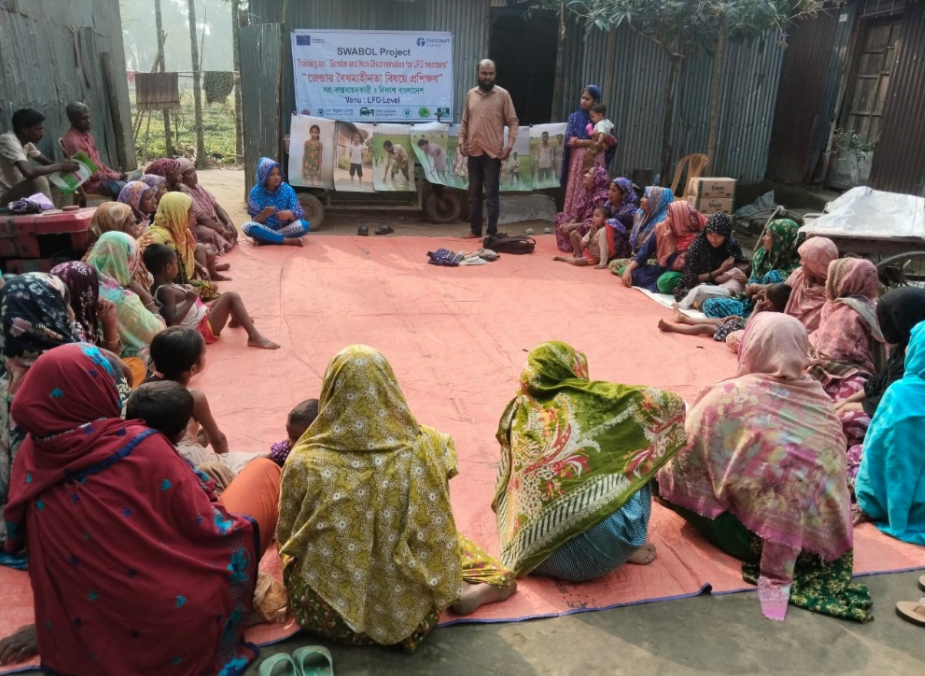
A gender workshop being held by a farmers association, Photo: Transform Trade
The project runs across 13 districts to help smallholder farmers become more self-reliant by strengthening their organisations so they can:
represent farmers' interests in local and national decision-making;
improve access to markets and agricultural services;
advocate for fairer agricultural and trade policies;
promote inclusion of women and other marginalised groups;
and build resilience to climate change through locally led adaptation.
By putting farmers at the centre of decisions, SWABOL is making lasting, locally led change. This requires helping Farmer-led Associations become stronger, better organised and more able to support smallholder farmers. Here’s how:
Registration and seed grants
So far, 31 of 46 Associations we work alongside are legally registered, giving them official recognition and helping them access government support, funding and services. The remaining Associations are currently going through the registration process. Being registered means that these Associations are legally recognised by the government, and that they can operate as independent organisations. Some of them are coordinating with government departments to access available financial support or grants.
SWABOL also gives Associations practical support, including seed grants for office rent, furniture, signboards, utilities and training. The first portions of seed grants have been provided, and are being used to expand their physical establishments, building their knowledge in key operational areas, meet regularly and plan for the future.
Advocacy and Inclusion
In rural Bangladesh, women’s livelihoods are volatile because of the heavy reliance on agriculture and the increased susceptibility to climate shocks.
They’re discriminated against and don’t enjoy equal rights in marriage, divorce, inheritance, and custody of children.
Deep-rooted beliefs that give more power to men than women, as well as discriminatory laws, wage discrimination and malnutrition among women perpetuate the problems. Women are underrepresented in the Bangladesh parliament and local politics, making it more difficult to challenge these injustices.
Through advocacy workshops, Association leaders, farmers, government officials and local journalists come together to discuss farmers’ priorities and agree practical next steps.
Inclusion is a big focus too. Associations support 1,580 Smallholder Farmer Organisations to discuss issues such as women’s economic independence, girls’ education, governance and climate change. They also mark moments like International Women’s Day and the 16 Days of Activism to raise awareness and strengthen women’s participation.
Transform trade has held workshops to capture community insights and lived experiences of gender inequality, and develop grassroots ownership. The findings from these workshops have enabled us to develop a gender mainstreaming framework for Farmer-led Associations. This framework strengthens Associations' capacity to integrate gender equity and ensure women's meaningful participation across their operations, advocacy and technical initiatives, particularly within planning and budgeting.