
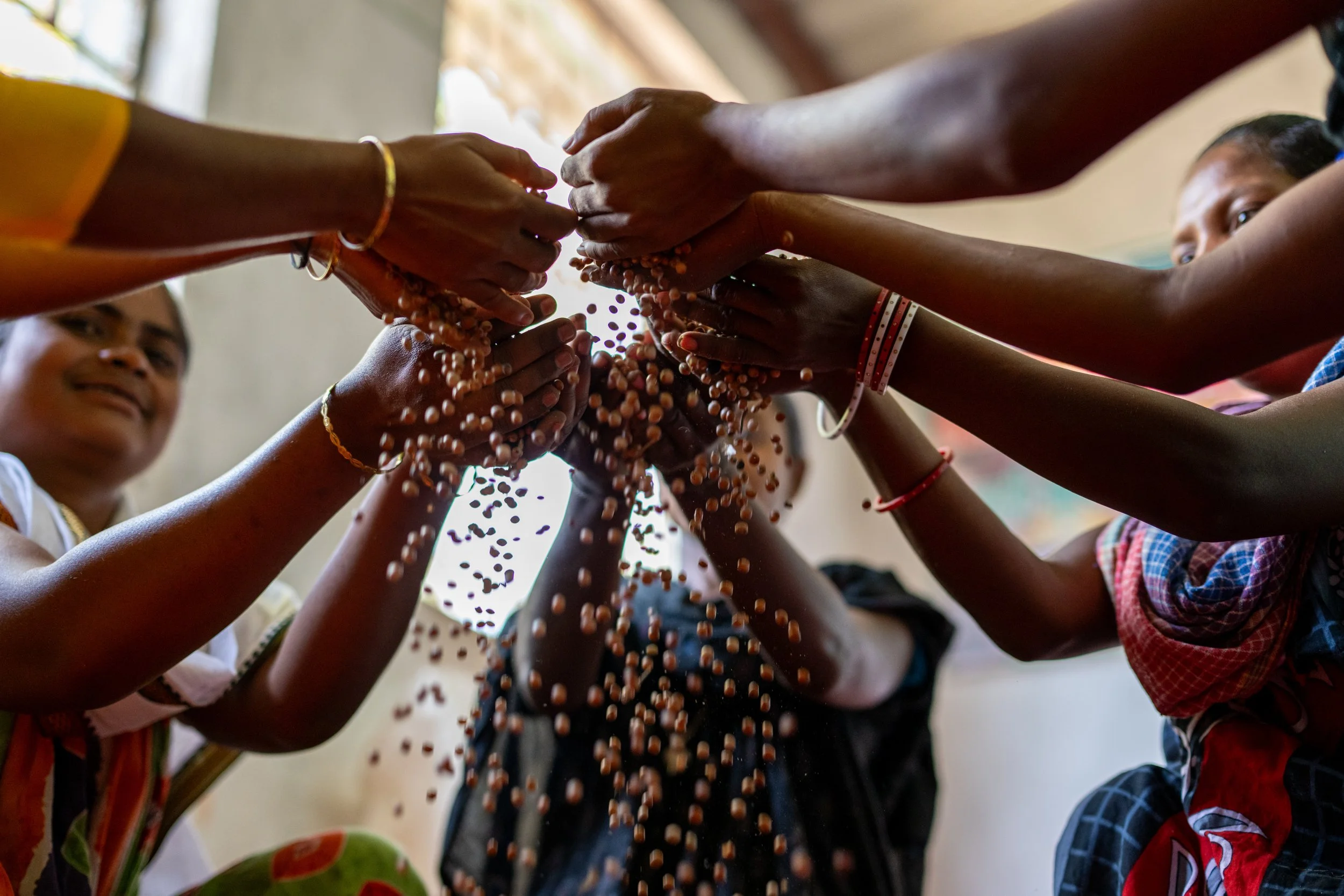
Photo credit: Ajaya Behera/Transform Trade
The Pahariya community is one of the most vulnerable tribes in India. They experience economic and social exclusion, as well as limited access to government services and schemes. This restricts their access to resources and opportunities, keeping them trapped in the cycle of poverty.
The community cultivates grains and vegetables, but their income has been steadily declining. They lack access to market information and have limited bargaining power to negotiate for fair prices for their produce. The Pahariya live in hard-to-reach areas and rely on middlemen, who exploit them by manipulating market prices for profit.
Climate change is disrupting traditional growing cycles and reducing agricultural productivity in India. The production of millet, a major source of nutrition for the Pahariya community, has been impacted by unpredictable weather patterns. Climate change has caused an increase in pest infestations that farmers lack knowledge of how to control.
Women provide most of the labour (paid or unpaid) in agriculture. However, they have a low literacy rate, do not own land, and lack spaces to advocate for their rights. Traditional gender roles limit their movement outside of their villages.
The SWALAMBAN project, funded by the Oak Foundation, and run by Transform Trade and our partner the Badlao Foundation, supports 3,500 Pahariya households in India to build long-term self-reliance, strengthen community leadership and create more secure livelihoods. Working alongside some of the most marginalised communities, the project is rooted in a simple but powerful principle: lasting change is strongest when it is led by the people it is designed to benefit.
At the heart of SWALAMBAN is the Pahariya community itself. The project will establish a Pahariya Leadership Council, bringing together community leaders, women’s federation members, traditional leaders and elected local representatives. With training in leadership, planning, marketing and management, council members are now equipped to identify challenges, develop solutions and share learning across all 3,500 households.
Another important focus is strengthening the women-led Farmer Producer Company. This community-owned platform helps Pahariya farmers receive fairer prices for their agricultural produce and access more stable markets. In this next phase, the project will support the company to improve its governance, develop a business plan, establish procurement centres and increase its annual turnover by more than 40%.
SWALAMBAN also recognises the importance of climate resilience. Households will receive support to improve agricultural practices, access soil testing and learn more about millet cultivation and traditional climate-resilient seeds. Community seed banks, farmer field schools and links with seed bank networks help protect indigenous knowledge while improving productivity and food security.
The project builds on earlier work by Transform Trade, which has already helped households access government schemes and services, establish the Farmer Producer Company, set up community-managed seed banks and create alternative marketing systems with fair prices.
By investing in leadership, fair markets and sustainable agriculture, SWALAMBAN is helping Pahariya communities shape their own future. Over time, the project aims to create a self-sustaining system that strengthens confidence, protects traditional knowledge and supports families to overcome future challenges with greater resilience.