The UK’s new deforestation rules: protecting forests without harming farmers
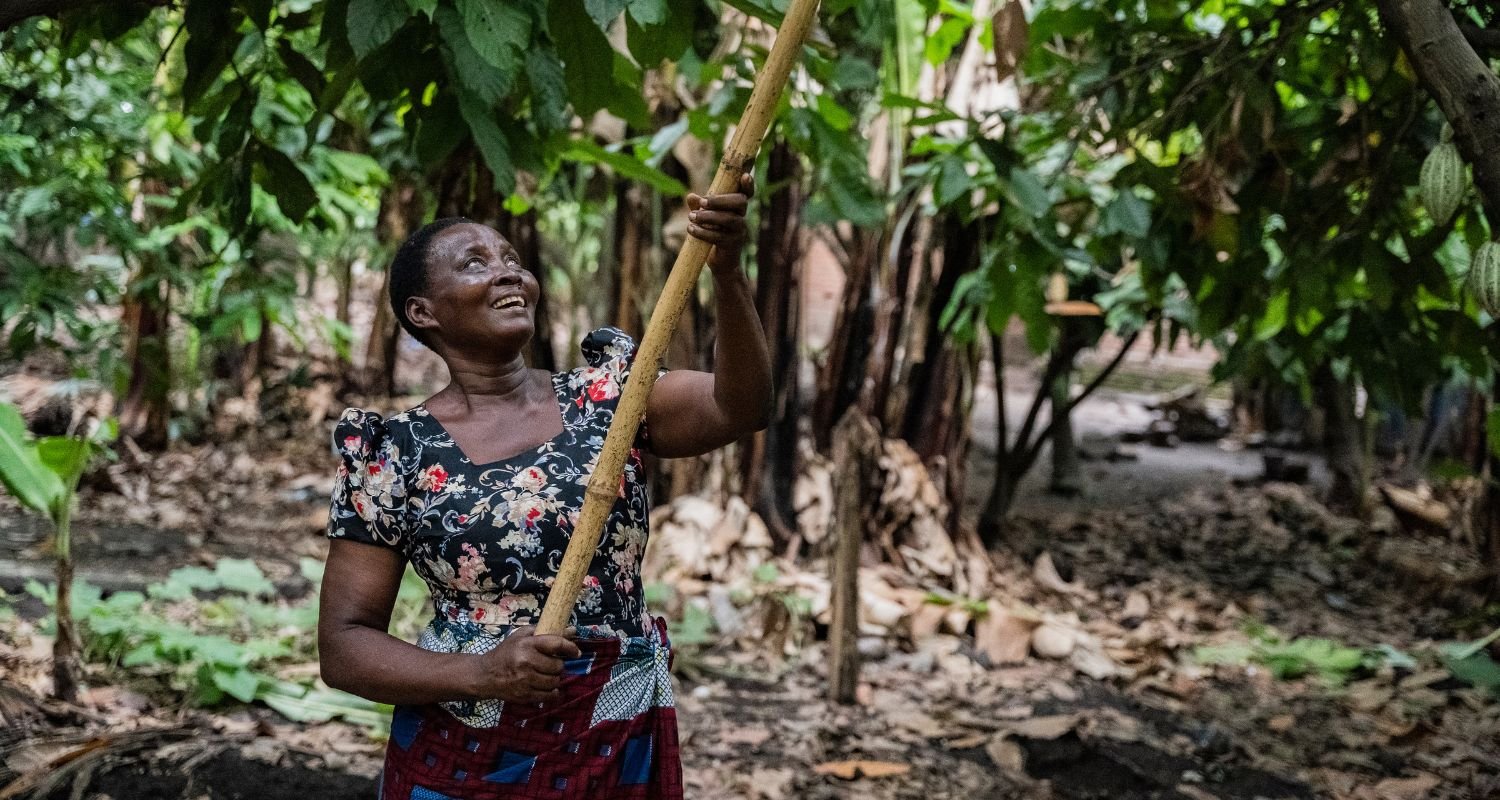
Enesti Jacobu Mwabusega is a cocoa farmer harvesting cocoa fruits on her farm. Cocoa products are in scope for these new regulations.
The UK Government recently announced its new approach to tackling deforestation in global supply chains. For years, campaigners have pushed for laws to stop the UK from importing products that destroy our planet’s vital forests. This announcement means regulations are officially on the way under the Environment Act 2021, with legislation expected to come in 2027.
This is a massive moment for nature and climate, but it brings a critical challenge. As these rules are shaped over the coming months, we must ensure that smallholder farmers are not unintentionally harmed by laws designed to protect forests.
What is the Government proposing?
The government will require UK businesses with an annual turnover of over £1 million to carry out strict due diligence on "forest risk commodities". This means that companies will have to report on how and where they are sourcing their products from and prove that these products are not linked to illegal deforestation.
This will apply to:
To prove they aren't causing illegal deforestation, UK companies will have to set up systems to collect mapping data of exact farm plots showing exactly where their products come from. Initially, the law will focus on blocking illegal deforestation based on local land laws, with plans to move toward a "zero-deforestation" standard in the future.
Smallholder farmers face hidden risks: In supply chains, corporations often push compliance costs and risks onto the people with the least power: smallholder farmers.
Smallholders in Africa, Asia, and Latin America produce over 90% of the world’s cocoa and 70-80% of its coffee. Millions of these farmers, many of whom are women, are already struggling due to low incomes, climate change, and volatile markets.
Mapping a farm isn’t straightforward. It needs smartphones, computers, internet access, and tech support. Data compliance for the EU's similar deforestation law (EUDR) already costs each cooperative an estimated £9,500 in Africa and £13,100 in Latin America. Without financial and technical support, many farmers risk being locked out of the UK market entirely.
For example, in Ethiopia's coffee sector, 55% of smallholders are currently not technically compliant with these data rules—even though in the vast majority of cases, they haven’t caused any deforestation.
What Transform Trade is calling for:
With a major government consultation expected at the end of 2026, we have a short window of opportunity to shape these laws. We are taking our message straight to decision-makers with three non-negotiable principles:
Companies must cover the costs: Protecting forests is a shared responsibility. Large businesses that profit from these commodities must pay for the geolocation technology and training, as well as paying fair prices to farmers, rather than squeezing their income and increasing their costs.
Fix problems, don’t walk away: If a case of non-compliance is found, companies shouldn't just cut ties and drop the supplier. They must have a responsible engagement strategy, by sending people to check the farm in person ("ground-truthing") and working with farmers to resolve the issue.
Data belongs to the farmers: tech companies and big brands shouldn't be allowed to harvest farm data. Farmers must own and control information about their own land, allowing them to reuse it for different buyers and markets - without being trapped by corporate platforms.
So what’s next?
The government has promised to make its system align closely with the EU’s regulations, so farmers don't have to navigate completely different rules. This is a good start, but we need to push harder. We want the upcoming government consultation translated into multiple languages, ensuring that the voices of civil society, farmers, and producer countries are genuinely heard.
We are also calling on the UK to introduce stronger laws requiring businesses to tackle the lack of living incomes and living wages in their supply chains. Poverty is a root cause of deforestation; you cannot protect trees without protecting the people who live among them.
As secondary legislation begins to move forward, we will be keeping the pressure on the UK Government. Thank you for standing with us to fight for a future that protects both our global forests and the farmers who feed us. Stay tuned for how you can get involved as the consultation approaches!